
Built by a mashgiach running the hallways, seder after seder.
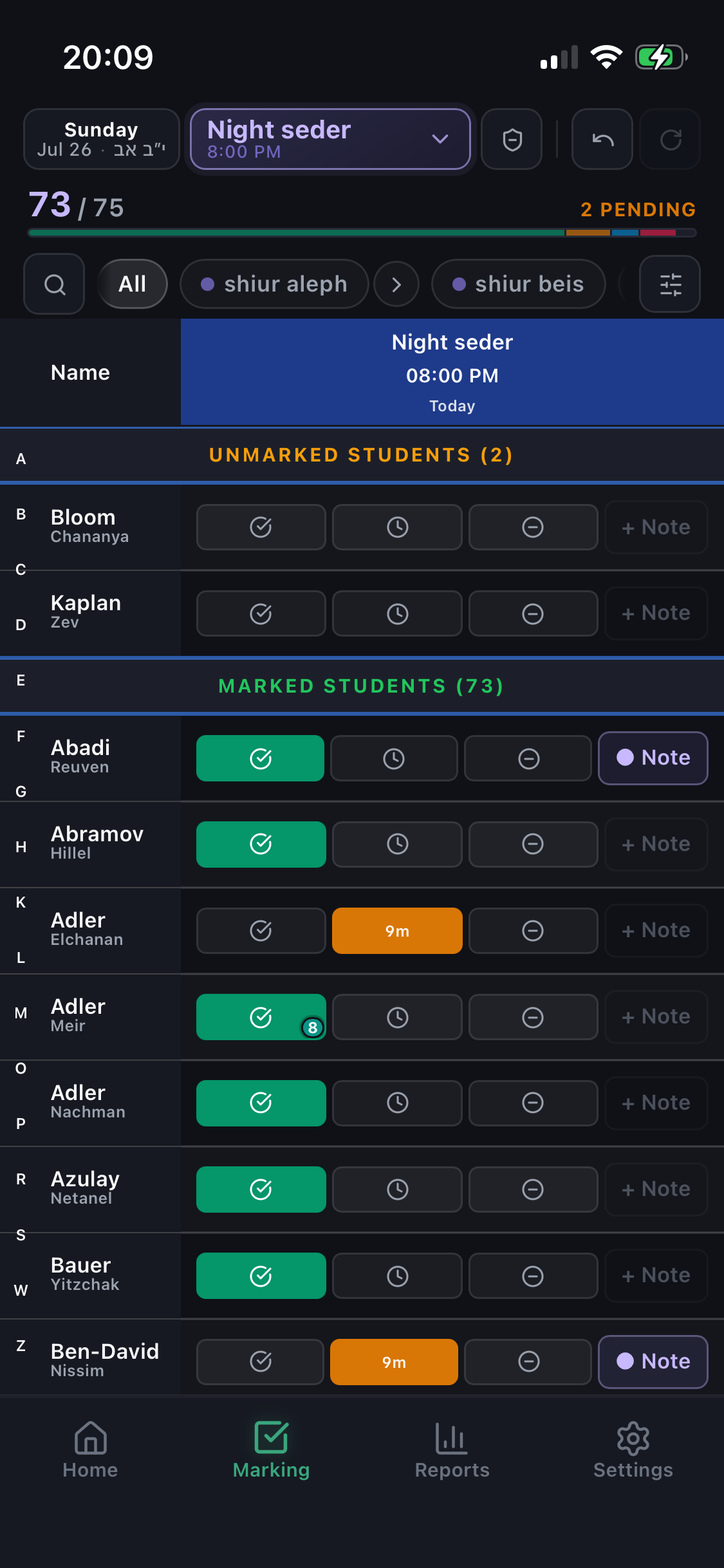
Night seder starts at 8:00. A bochur walks in at 8:07, the rebbi taps him late, and that is the whole of his job — the app knows the class began at 8:00, so the seven minutes, and what those seven minutes do to his percentage, are worked out for him. Nobody types a number. When the seder ends, whoever was never tapped at all is closed out as absent on his own, and the boy away for the week is already excused from a rule someone wrote weeks ago.
That is the split, and it is the point: the mashgiach still marks. He is the one standing in the room, and no software should pretend to know who walked in. What it should do is the counting, the arithmetic and the paperwork behind it — which is the part that used to eat his evening.
What happens without anyone doing it
Minutes late, counted from the second the class starts
You tap late; you do not type how late. No stopwatch, no “he came in around ten after” — the class has a start time, so the minutes are arithmetic the app does live while the seder runs. They land in the percentage as partial credit too: a boy who missed ten minutes is not scored the same as a boy who missed the whole seder, and nobody works that fraction out by hand.
The roll closes itself
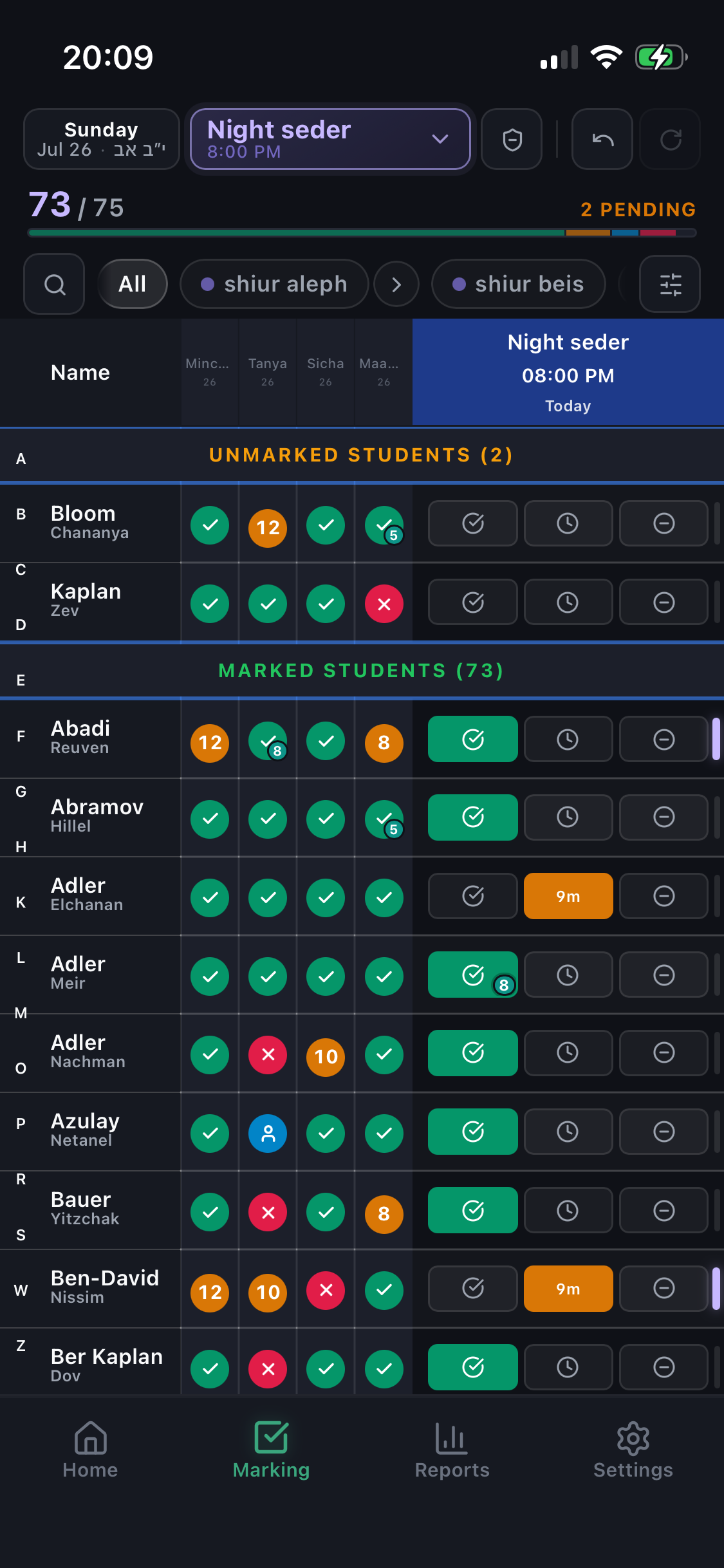
When the class ends, every boy still unmarked is written down as absent automatically. Nobody comes back at eleven at night to finish a list, and no seder quietly ends up with half a roll — which is how attendance records rot in the first place.
The last four classes, beside every name
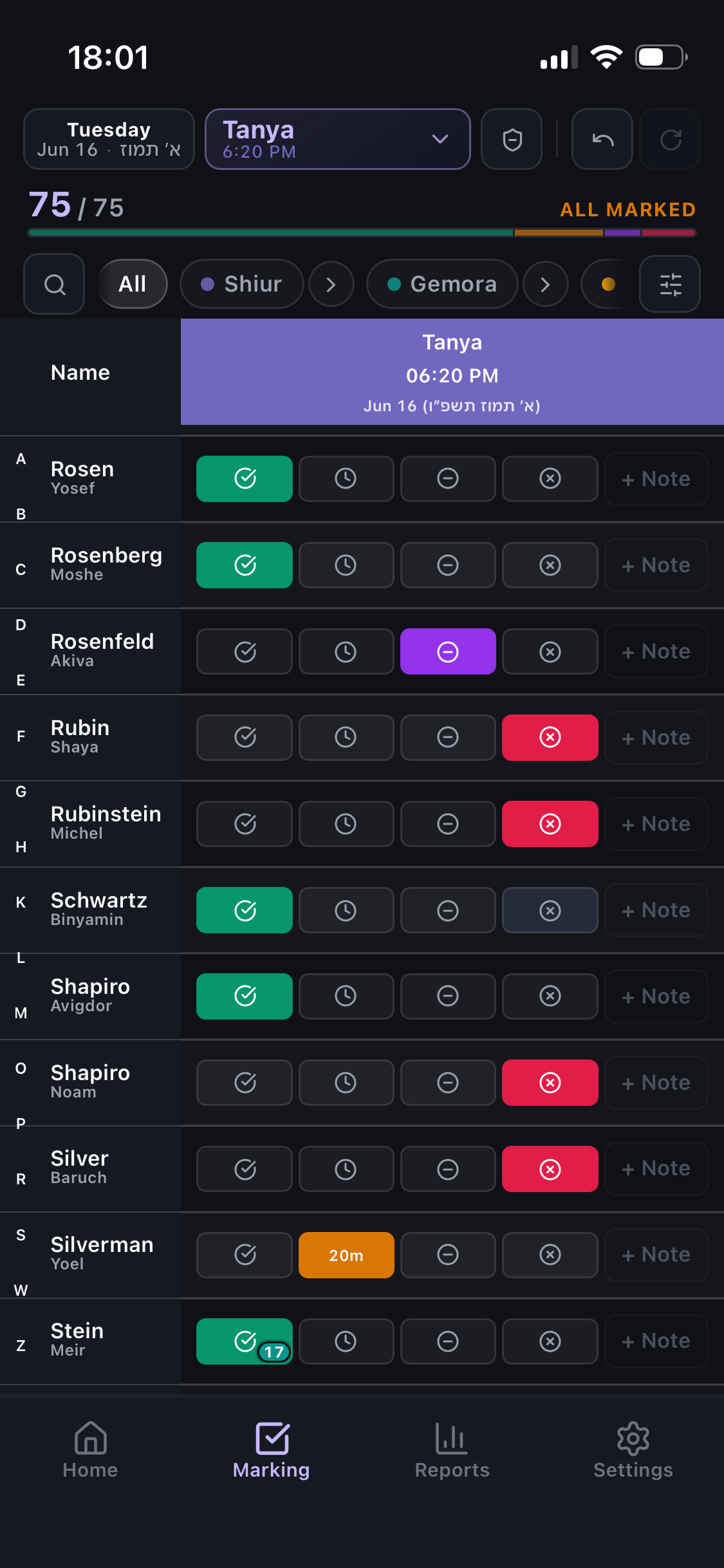
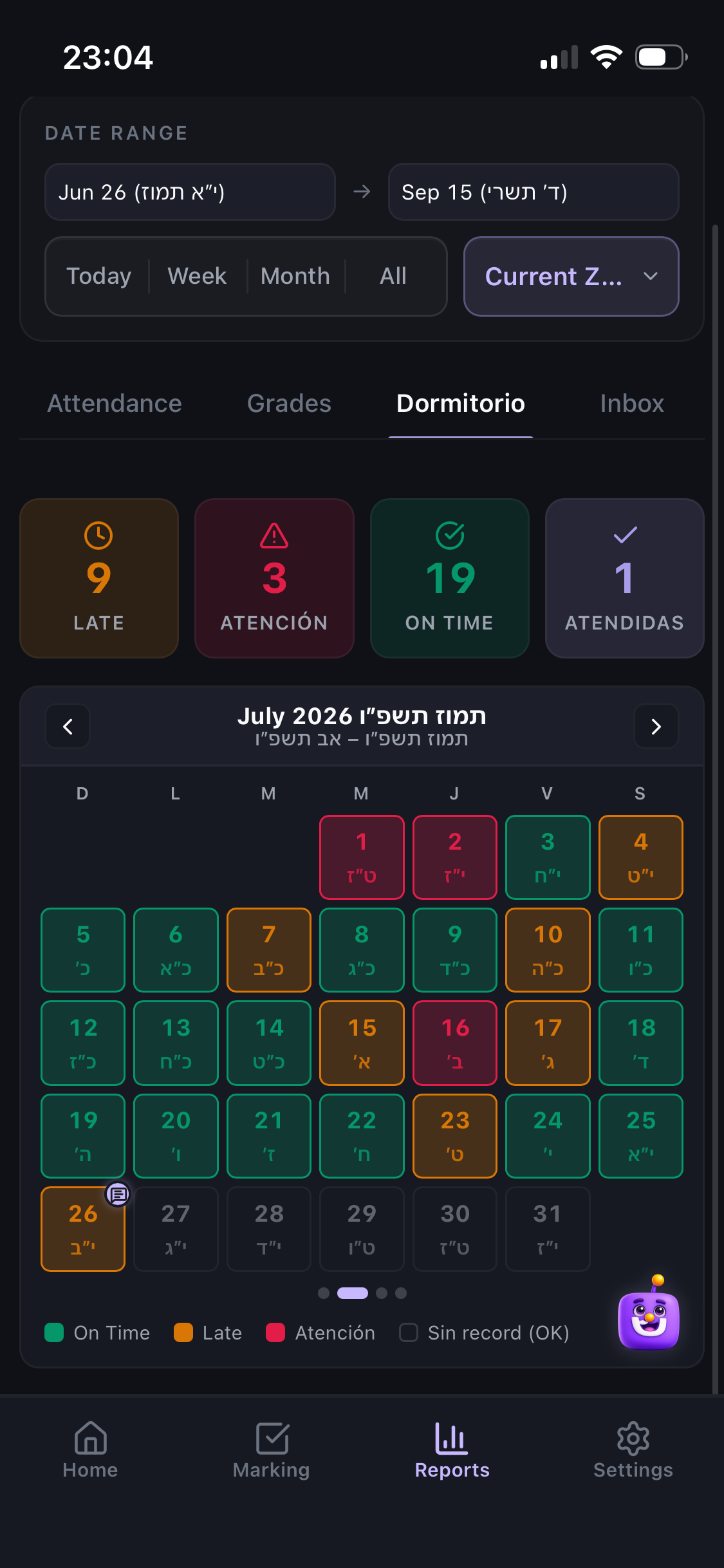
Those small coloured circles next to each bochur are his last four classes — green on time, orange with the minutes he was late, red absent, purple excused. You are not marking blind: while you take today, you can see that a boy has slipped three of the last four, or that the one you were worried about has been on time all week. The pattern is there before anyone opens a report, which is what makes it possible to say something while it still helps.
An excuse written once, applied forever
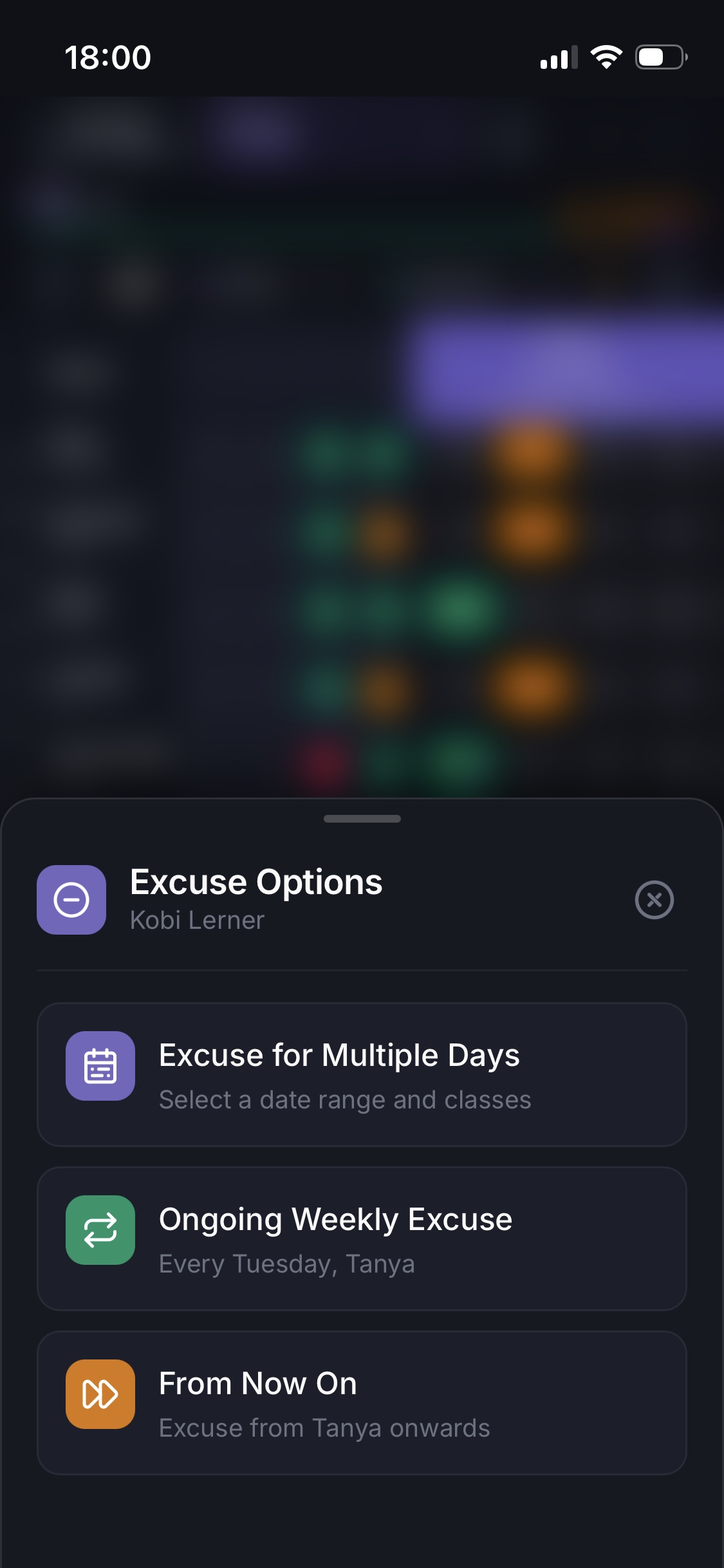
Home for a week. A standing appointment every Tuesday. Away for a simcha. The excuse is entered as a rule with the days and the sedorim it covers, and from then on every day it touches resolves itself — including days that have not happened yet. Nobody re-marks anything, ever.
The Hebrew date is not a translation, it is the calendar
Every date in the app carries its Hebrew date beside it — on the marking screen, in the reports, on the report card, in the parent’s email. You pick a range by zman instead of by quarter, and the date picker itself speaks Hebrew dates. In Hebrew the screens and the reports run right-to-left properly, not as mirrored English.
The bochur is not just being counted
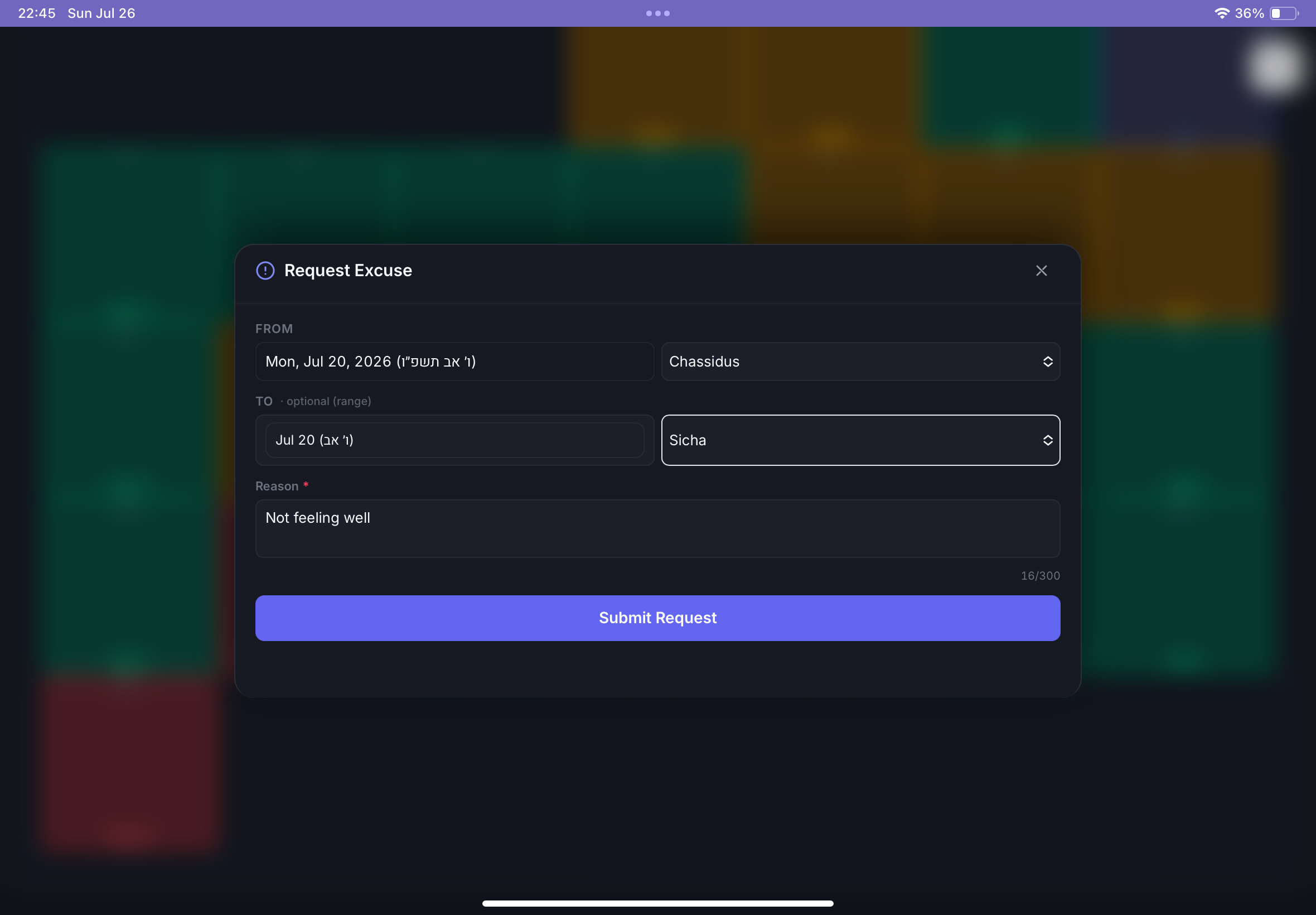
A talmid opens his own report and sees exactly where he stands — his percentage, his trend, how the last weeks actually went. If a class was missed and the reason never reached anyone, he requests the excuse himself from inside that report; it lands in the staff Inbox and someone approves or declines it with one tap.
That changes the frame. The number stops being something done to him and becomes something he is holding, which is exactly when a bochur starts pushing himself. Each school decides how much of it he sees — percentage, trend, the breakdown per class — and can switch the request off entirely.

A guide who has already read every record
Shmirr is the assistant built into the app. Think of him less as a search box and more as someone who sits with the whole file open: he has your talmidim, your sedorim, your zman and every mark and excuse in front of him, and he answers in plain language. “Who is under 80 this zman.” “How is Levi trending since Rosh Chodesh.” “Which boys in shiur beis came late more than three times last week.” No filters to set up, no report to build, no export.
He reads the same records the reports do — the same engine, not a separate copy — so what he tells you cannot quietly disagree with the report card you print an hour later. And he only ever sees your school: the isolation is enforced in the database, not in the wording of a prompt.
Ask him things like
Who is under 80% this zman?
Six talmidim: Yitzchak Bauer 71%, Nachman Adler 74%, Gedalya Weiss 76%, Netanel Azulay 78%, Dov Ber Kaplan 79%, Dani Geller 79%. Bauer and Adler are both losing it on night seder rather than across the day.
How is Levi Adler trending this month?
Up. He was at 81% two weeks ago and he is at 89% now, and his last seven sedorim were all on time. What is left is Shacharis, where he is still late about half the week.
Which bochurim improved the most since Rosh Chodesh?
Levi Adler +8 points, Hillel Abramov +6 and Dov Ber Kaplan +5. All three improved by arriving on time, not by missing fewer sedorim.
Who came late more than three times last week?
Four: Reuven Abadi 5 times, Nachman Adler 4, Netanel Azulay 4 and Dani Geller 4. Three of Dani’s were dorm curfew rather than seder.
Example answers, demo school.
And a good deal more than attendance
Tap any of these — same record, same talmid.
One number, wherever it shows up
The percentage on the rebbi’s screen, the one in the email home, the one printed on the report card and the one on the link a parent opens are the same number, from the same engine. That is not something a school should have to go and verify, and it is exactly what goes quietly wrong in systems that grew one report at a time. Here it is one calculation, with tests that fail the moment a second one appears.
Who it is for
Yeshivos, mesivtas and frum schools that take attendance seriously enough to act on it: with a dormitory, with more than one shiur per grade, with parents who want to know, and with a menahel who would rather see the number than chase it.
One month free. No credit card.
Set up your school, mark a real seder, and see the report the same day.